Class No.07  Data Structures http://ecomputernotes.com
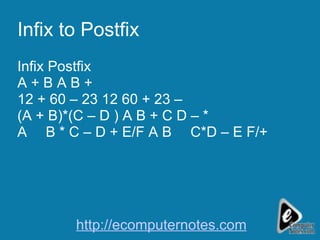
Infix to Postfix Infix Postfix A + B A B + 12 + 60 – 23 12 60 + 23 – (A + B)*(C – D ) A B + C D – * A  B * C – D + E/F A B  C*D – E F/+ http://ecomputernotes.com
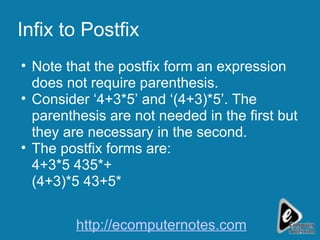
Infix to Postfix Note that the postfix form an expression does not require parenthesis. Consider ‘4+3*5’ and ‘(4+3)*5’. The parenthesis are not needed in the first but they are necessary in the second. The postfix forms are: 4+3*5 435*+  (4+3)*5 43+5* http://ecomputernotes.com
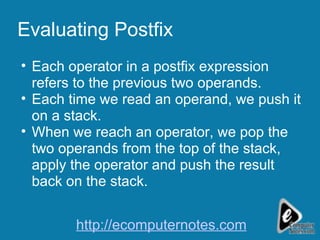
Evaluating Postfix  Each operator in a postfix expression refers to the previous two operands. Each time we read an operand, we push it on a stack. When we reach an operator, we pop the two operands from the top of the stack, apply the operator and push the result back on the stack.  http://ecomputernotes.com
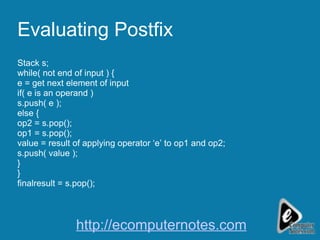
Evaluating Postfix Stack s; while( not end of input ) { e = get next element of input if( e is an operand ) s.push( e ); else { op2 = s.pop(); op1 = s.pop(); value = result of applying operator ‘e’ to op1 and op2; s.push( value ); } } finalresult = s.pop(); http://ecomputernotes.com
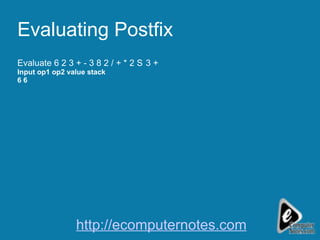
Evaluating Postfix Evaluate 6 2 3 + - 3 8 2 / + * 2  3 + Input op1 op2 value stack 6 6 http://ecomputernotes.com
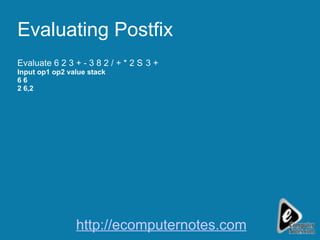
Evaluating Postfix Evaluate 6 2 3 + - 3 8 2 / + * 2  3 + Input op1 op2 value stack 6 6 2 6,2 http://ecomputernotes.com
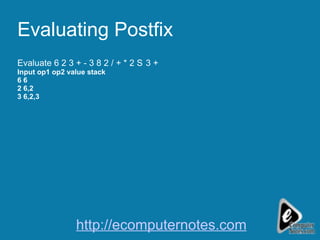
Evaluating Postfix Evaluate 6 2 3 + - 3 8 2 / + * 2  3 + Input op1 op2 value stack 6 6 2 6,2 3 6,2,3 http://ecomputernotes.com
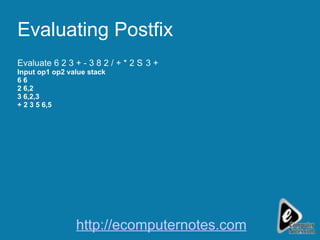
Evaluating Postfix Evaluate 6 2 3 + - 3 8 2 / + * 2  3 + Input op1 op2 value stack 6 6 2 6,2 3 6,2,3 + 2 3 5 6,5 http://ecomputernotes.com
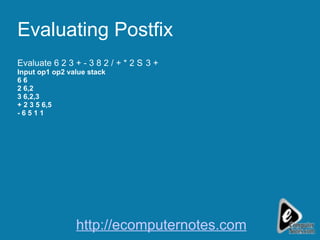
Evaluating Postfix Evaluate 6 2 3 + - 3 8 2 / + * 2  3 + Input op1 op2 value stack 6 6 2 6,2 3 6,2,3 + 2 3 5 6,5 - 6 5 1 1 http://ecomputernotes.com
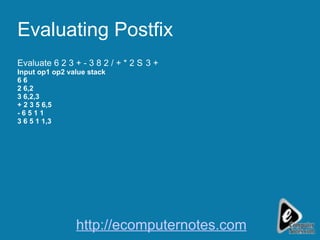
Evaluating Postfix Evaluate 6 2 3 + - 3 8 2 / + * 2  3 + Input op1 op2 value stack 6 6 2 6,2 3 6,2,3 + 2 3 5 6,5 - 6 5 1 1 3 6 5 1 1,3 http://ecomputernotes.com
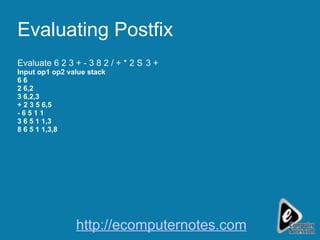
Evaluating Postfix Evaluate 6 2 3 + - 3 8 2 / + * 2  3 + Input op1 op2 value stack 6 6 2 6,2 3 6,2,3 + 2 3 5 6,5 - 6 5 1 1 3 6 5 1 1,3 8 6 5 1 1,3,8 http://ecomputernotes.com
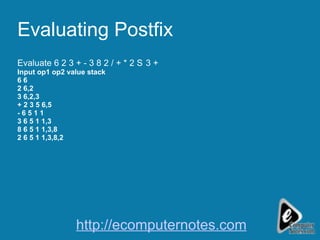
Evaluating Postfix Evaluate 6 2 3 + - 3 8 2 / + * 2  3 + Input op1 op2 value stack 6 6 2 6,2 3 6,2,3 + 2 3 5 6,5 - 6 5 1 1 3 6 5 1 1,3 8 6 5 1 1,3,8 2 6 5 1 1,3,8,2 http://ecomputernotes.com
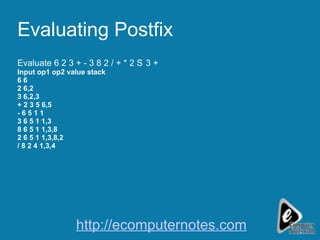
Evaluating Postfix Evaluate 6 2 3 + - 3 8 2 / + * 2  3 + Input op1 op2 value stack 6 6 2 6,2 3 6,2,3 + 2 3 5 6,5 - 6 5 1 1 3 6 5 1 1,3 8 6 5 1 1,3,8 2 6 5 1 1,3,8,2 / 8 2 4 1,3,4 http://ecomputernotes.com
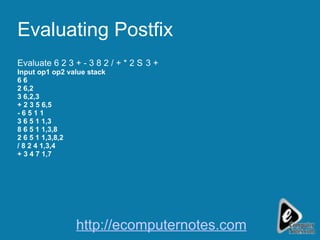
Evaluating Postfix Evaluate 6 2 3 + - 3 8 2 / + * 2  3 + Input op1 op2 value stack 6 6 2 6,2 3 6,2,3 + 2 3 5 6,5 - 6 5 1 1 3 6 5 1 1,3 8 6 5 1 1,3,8 2 6 5 1 1,3,8,2 / 8 2 4 1,3,4 + 3 4 7 1,7 http://ecomputernotes.com
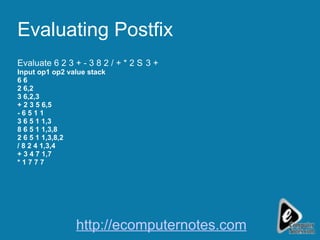
Evaluating Postfix Evaluate 6 2 3 + - 3 8 2 / + * 2  3 + Input op1 op2 value stack 6 6 2 6,2 3 6,2,3 + 2 3 5 6,5 - 6 5 1 1 3 6 5 1 1,3 8 6 5 1 1,3,8 2 6 5 1 1,3,8,2 / 8 2 4 1,3,4 + 3 4 7 1,7 * 1 7 7 7 http://ecomputernotes.com
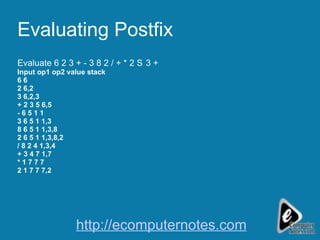
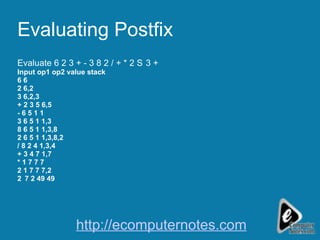
Evaluating Postfix Evaluate 6 2 3 + - 3 8 2 / + * 2  3 + Input op1 op2 value stack 6 6 2 6,2 3 6,2,3 + 2 3 5 6,5 - 6 5 1 1 3 6 5 1 1,3 8 6 5 1 1,3,8 2 6 5 1 1,3,8,2 / 8 2 4 1,3,4 + 3 4 7 1,7 * 1 7 7 7 2 1 7 7 7,2 http://ecomputernotes.com
Evaluating Postfix Evaluate 6 2 3 + - 3 8 2 / + * 2  3 + Input op1 op2 value stack 6 6 2 6,2 3 6,2,3 + 2 3 5 6,5 - 6 5 1 1 3 6 5 1 1,3 8 6 5 1 1,3,8 2 6 5 1 1,3,8,2 / 8 2 4 1,3,4 + 3 4 7 1,7 * 1 7 7 7 2 1 7 7 7,2   7 2 49 49 http://ecomputernotes.com
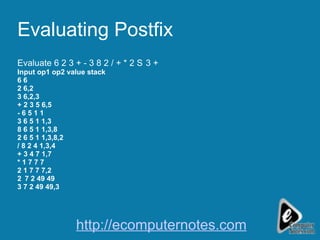
Evaluating Postfix Evaluate 6 2 3 + - 3 8 2 / + * 2  3 + Input op1 op2 value stack 6 6 2 6,2 3 6,2,3 + 2 3 5 6,5 - 6 5 1 1 3 6 5 1 1,3 8 6 5 1 1,3,8 2 6 5 1 1,3,8,2 / 8 2 4 1,3,4 + 3 4 7 1,7 * 1 7 7 7 2 1 7 7 7,2   7 2 49 49 3 7 2 49 49,3 http://ecomputernotes.com
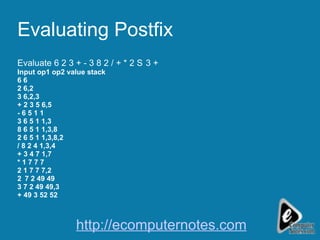
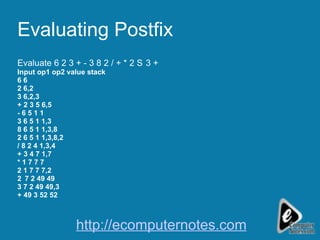
Evaluating Postfix Evaluate 6 2 3 + - 3 8 2 / + * 2  3 + Input op1 op2 value stack 6 6 2 6,2 3 6,2,3 + 2 3 5 6,5 - 6 5 1 1 3 6 5 1 1,3 8 6 5 1 1,3,8 2 6 5 1 1,3,8,2 / 8 2 4 1,3,4 + 3 4 7 1,7 * 1 7 7 7 2 1 7 7 7,2   7 2 49 49 3 7 2 49 49,3 + 49 3 52 52 http://ecomputernotes.com
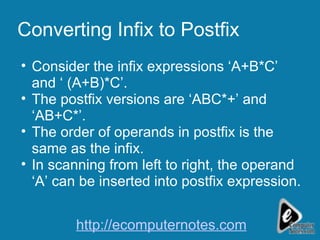
Converting Infix to Postfix Consider the infix expressions ‘A+B*C’ and ‘ (A+B)*C’.  The postfix versions are ‘ABC*+’ and ‘AB+C*’. The order of operands in postfix is the same as the infix. In scanning from left to right, the operand ‘A’ can be inserted into postfix expression. http://ecomputernotes.com
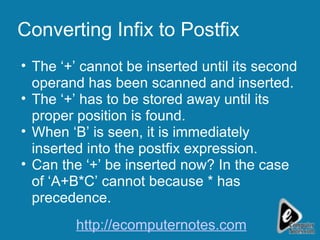
Converting Infix to Postfix The ‘+’ cannot be inserted until its second operand has been scanned and inserted. The ‘+’ has to be stored away until its proper position is found. When ‘B’ is seen, it is immediately inserted into the postfix expression. Can the ‘+’ be inserted now? In the case of ‘A+B*C’ cannot because * has precedence. http://ecomputernotes.com
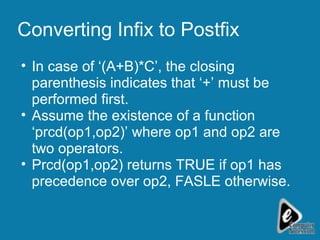
Converting Infix to Postfix In case of ‘(A+B)*C’, the closing parenthesis indicates that ‘+’ must be performed first. Assume the existence of a function ‘prcd(op1,op2)’ where op1 and op2 are two operators. Prcd(op1,op2) returns TRUE if op1 has precedence over op2, FASLE otherwise.
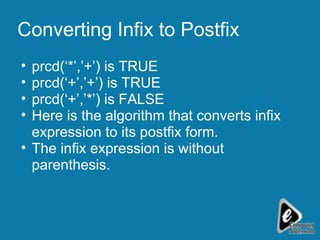
Converting Infix to Postfix prcd(‘*’,’+’) is TRUE prcd(‘+’,’+’) is TRUE prcd(‘+’,’*’) is FALSE  Here is the algorithm that converts infix expression to its postfix form. The infix expression is without parenthesis.
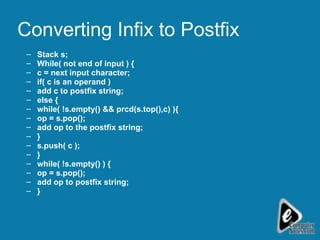
Converting Infix to Postfix Stack s; While( not end of input ) { c = next input character;  if( c is an operand ) add c to postfix string; else { while( !s.empty() && prcd(s.top(),c) ){ op = s.pop();  add op to the postfix string; } s.push( c ); } while( !s.empty() ) { op = s.pop(); add op to postfix string; }
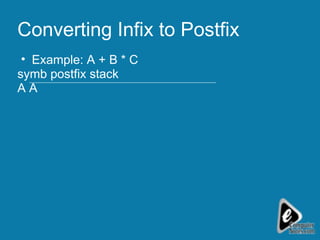
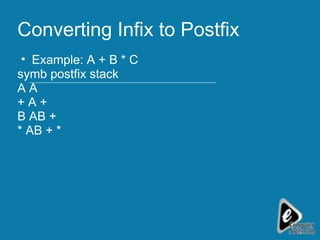
Converting Infix to Postfix Example: A + B * C symb postfix stack A A
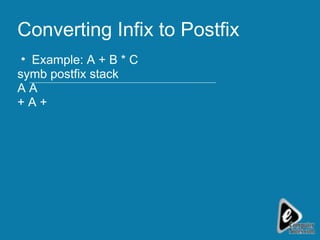
Converting Infix to Postfix Example: A + B * C symb postfix stack A A + A +
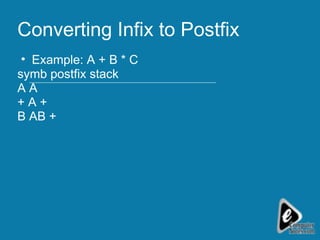
Converting Infix to Postfix Example: A + B * C symb postfix stack A A + A + B AB +
Converting Infix to Postfix Example: A + B * C symb postfix stack A A + A + B AB + * AB + *
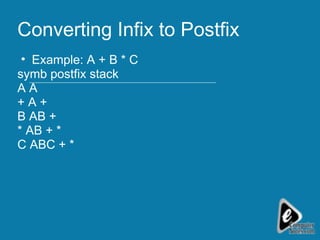
Converting Infix to Postfix Example: A + B * C symb postfix stack A A + A + B AB + * AB + * C ABC + *
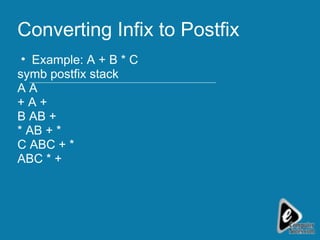
Converting Infix to Postfix Example: A + B * C symb postfix stack A A + A + B AB + * AB + * C ABC + * ABC * +
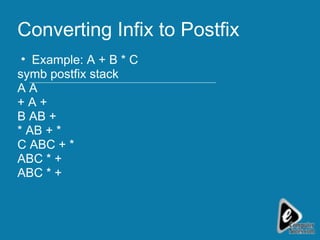
Converting Infix to Postfix Example: A + B * C symb postfix stack A A + A + B AB + * AB + * C ABC + * ABC * + ABC * +
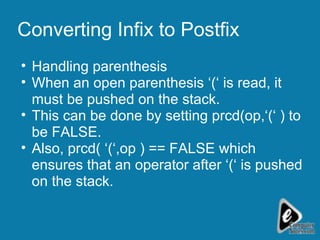
Converting Infix to Postfix Handling parenthesis When an open parenthesis ‘(‘ is read, it must be pushed on the stack. This can be done by setting prcd(op,‘(‘ ) to be FALSE.  Also, prcd( ‘(‘,op ) == FALSE which ensures that an operator after ‘(‘ is pushed on the stack.
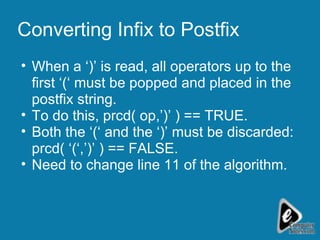
Converting Infix to Postfix When a ‘)’ is read, all operators up to the first ‘(‘ must be popped and placed in the postfix string. To do this, prcd( op,’)’ ) == TRUE. Both the ‘(‘ and the ‘)’ must be discarded: prcd( ‘(‘,’)’ ) == FALSE. Need to change line 11 of the algorithm.
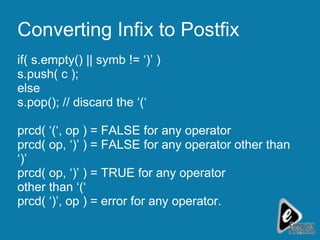
Converting Infix to Postfix if( s.empty() || symb != ‘)’ )  s.push( c ); else s.pop(); // discard the ‘(‘  prcd( ‘(‘, op ) = FALSE for any operator prcd( op, ‘)’ ) = FALSE for any operator other than ‘)’ prcd( op, ‘)’ ) = TRUE for any operator  other than ‘(‘ prcd( ‘)’, op ) = error for any operator.

computer notes - Data Structures - 7

  • 1.
    Class No.07 Data Structures http://ecomputernotes.com
  • 2.
    Infix to PostfixInfix Postfix A + B A B + 12 + 60 – 23 12 60 + 23 – (A + B)*(C – D ) A B + C D – * A  B * C – D + E/F A B  C*D – E F/+ http://ecomputernotes.com
  • 3.
    Infix to PostfixNote that the postfix form an expression does not require parenthesis. Consider ‘4+3*5’ and ‘(4+3)*5’. The parenthesis are not needed in the first but they are necessary in the second. The postfix forms are: 4+3*5 435*+ (4+3)*5 43+5* http://ecomputernotes.com
  • 4.
    Evaluating Postfix Each operator in a postfix expression refers to the previous two operands. Each time we read an operand, we push it on a stack. When we reach an operator, we pop the two operands from the top of the stack, apply the operator and push the result back on the stack. http://ecomputernotes.com
  • 5.
    Evaluating Postfix Stacks; while( not end of input ) { e = get next element of input if( e is an operand ) s.push( e ); else { op2 = s.pop(); op1 = s.pop(); value = result of applying operator ‘e’ to op1 and op2; s.push( value ); } } finalresult = s.pop(); http://ecomputernotes.com
  • 6.
    Evaluating Postfix Evaluate6 2 3 + - 3 8 2 / + * 2  3 + Input op1 op2 value stack 6 6 http://ecomputernotes.com
  • 7.
    Evaluating Postfix Evaluate6 2 3 + - 3 8 2 / + * 2  3 + Input op1 op2 value stack 6 6 2 6,2 http://ecomputernotes.com
  • 8.
    Evaluating Postfix Evaluate6 2 3 + - 3 8 2 / + * 2  3 + Input op1 op2 value stack 6 6 2 6,2 3 6,2,3 http://ecomputernotes.com
  • 9.
    Evaluating Postfix Evaluate6 2 3 + - 3 8 2 / + * 2  3 + Input op1 op2 value stack 6 6 2 6,2 3 6,2,3 + 2 3 5 6,5 http://ecomputernotes.com
  • 10.
    Evaluating Postfix Evaluate6 2 3 + - 3 8 2 / + * 2  3 + Input op1 op2 value stack 6 6 2 6,2 3 6,2,3 + 2 3 5 6,5 - 6 5 1 1 http://ecomputernotes.com
  • 11.
    Evaluating Postfix Evaluate6 2 3 + - 3 8 2 / + * 2  3 + Input op1 op2 value stack 6 6 2 6,2 3 6,2,3 + 2 3 5 6,5 - 6 5 1 1 3 6 5 1 1,3 http://ecomputernotes.com
  • 12.
    Evaluating Postfix Evaluate6 2 3 + - 3 8 2 / + * 2  3 + Input op1 op2 value stack 6 6 2 6,2 3 6,2,3 + 2 3 5 6,5 - 6 5 1 1 3 6 5 1 1,3 8 6 5 1 1,3,8 http://ecomputernotes.com
  • 13.
    Evaluating Postfix Evaluate6 2 3 + - 3 8 2 / + * 2  3 + Input op1 op2 value stack 6 6 2 6,2 3 6,2,3 + 2 3 5 6,5 - 6 5 1 1 3 6 5 1 1,3 8 6 5 1 1,3,8 2 6 5 1 1,3,8,2 http://ecomputernotes.com
  • 14.
    Evaluating Postfix Evaluate6 2 3 + - 3 8 2 / + * 2  3 + Input op1 op2 value stack 6 6 2 6,2 3 6,2,3 + 2 3 5 6,5 - 6 5 1 1 3 6 5 1 1,3 8 6 5 1 1,3,8 2 6 5 1 1,3,8,2 / 8 2 4 1,3,4 http://ecomputernotes.com
  • 15.
    Evaluating Postfix Evaluate6 2 3 + - 3 8 2 / + * 2  3 + Input op1 op2 value stack 6 6 2 6,2 3 6,2,3 + 2 3 5 6,5 - 6 5 1 1 3 6 5 1 1,3 8 6 5 1 1,3,8 2 6 5 1 1,3,8,2 / 8 2 4 1,3,4 + 3 4 7 1,7 http://ecomputernotes.com
  • 16.
    Evaluating Postfix Evaluate6 2 3 + - 3 8 2 / + * 2  3 + Input op1 op2 value stack 6 6 2 6,2 3 6,2,3 + 2 3 5 6,5 - 6 5 1 1 3 6 5 1 1,3 8 6 5 1 1,3,8 2 6 5 1 1,3,8,2 / 8 2 4 1,3,4 + 3 4 7 1,7 * 1 7 7 7 http://ecomputernotes.com
  • 17.
    Evaluating Postfix Evaluate6 2 3 + - 3 8 2 / + * 2  3 + Input op1 op2 value stack 6 6 2 6,2 3 6,2,3 + 2 3 5 6,5 - 6 5 1 1 3 6 5 1 1,3 8 6 5 1 1,3,8 2 6 5 1 1,3,8,2 / 8 2 4 1,3,4 + 3 4 7 1,7 * 1 7 7 7 2 1 7 7 7,2 http://ecomputernotes.com
  • 18.
    Evaluating Postfix Evaluate6 2 3 + - 3 8 2 / + * 2  3 + Input op1 op2 value stack 6 6 2 6,2 3 6,2,3 + 2 3 5 6,5 - 6 5 1 1 3 6 5 1 1,3 8 6 5 1 1,3,8 2 6 5 1 1,3,8,2 / 8 2 4 1,3,4 + 3 4 7 1,7 * 1 7 7 7 2 1 7 7 7,2  7 2 49 49 http://ecomputernotes.com
  • 19.
    Evaluating Postfix Evaluate6 2 3 + - 3 8 2 / + * 2  3 + Input op1 op2 value stack 6 6 2 6,2 3 6,2,3 + 2 3 5 6,5 - 6 5 1 1 3 6 5 1 1,3 8 6 5 1 1,3,8 2 6 5 1 1,3,8,2 / 8 2 4 1,3,4 + 3 4 7 1,7 * 1 7 7 7 2 1 7 7 7,2  7 2 49 49 3 7 2 49 49,3 http://ecomputernotes.com
  • 20.
    Evaluating Postfix Evaluate6 2 3 + - 3 8 2 / + * 2  3 + Input op1 op2 value stack 6 6 2 6,2 3 6,2,3 + 2 3 5 6,5 - 6 5 1 1 3 6 5 1 1,3 8 6 5 1 1,3,8 2 6 5 1 1,3,8,2 / 8 2 4 1,3,4 + 3 4 7 1,7 * 1 7 7 7 2 1 7 7 7,2  7 2 49 49 3 7 2 49 49,3 + 49 3 52 52 http://ecomputernotes.com
  • 21.
    Evaluating Postfix Evaluate6 2 3 + - 3 8 2 / + * 2  3 + Input op1 op2 value stack 6 6 2 6,2 3 6,2,3 + 2 3 5 6,5 - 6 5 1 1 3 6 5 1 1,3 8 6 5 1 1,3,8 2 6 5 1 1,3,8,2 / 8 2 4 1,3,4 + 3 4 7 1,7 * 1 7 7 7 2 1 7 7 7,2  7 2 49 49 3 7 2 49 49,3 + 49 3 52 52 http://ecomputernotes.com
  • 22.
    Converting Infix toPostfix Consider the infix expressions ‘A+B*C’ and ‘ (A+B)*C’. The postfix versions are ‘ABC*+’ and ‘AB+C*’. The order of operands in postfix is the same as the infix. In scanning from left to right, the operand ‘A’ can be inserted into postfix expression. http://ecomputernotes.com
  • 23.
    Converting Infix toPostfix The ‘+’ cannot be inserted until its second operand has been scanned and inserted. The ‘+’ has to be stored away until its proper position is found. When ‘B’ is seen, it is immediately inserted into the postfix expression. Can the ‘+’ be inserted now? In the case of ‘A+B*C’ cannot because * has precedence. http://ecomputernotes.com
  • 24.
    Converting Infix toPostfix In case of ‘(A+B)*C’, the closing parenthesis indicates that ‘+’ must be performed first. Assume the existence of a function ‘prcd(op1,op2)’ where op1 and op2 are two operators. Prcd(op1,op2) returns TRUE if op1 has precedence over op2, FASLE otherwise.
  • 25.
    Converting Infix toPostfix prcd(‘*’,’+’) is TRUE prcd(‘+’,’+’) is TRUE prcd(‘+’,’*’) is FALSE Here is the algorithm that converts infix expression to its postfix form. The infix expression is without parenthesis.
  • 26.
    Converting Infix toPostfix Stack s; While( not end of input ) { c = next input character; if( c is an operand ) add c to postfix string; else { while( !s.empty() && prcd(s.top(),c) ){ op = s.pop(); add op to the postfix string; } s.push( c ); } while( !s.empty() ) { op = s.pop(); add op to postfix string; }
  • 27.
    Converting Infix toPostfix Example: A + B * C symb postfix stack A A
  • 28.
    Converting Infix toPostfix Example: A + B * C symb postfix stack A A + A +
  • 29.
    Converting Infix toPostfix Example: A + B * C symb postfix stack A A + A + B AB +
  • 30.
    Converting Infix toPostfix Example: A + B * C symb postfix stack A A + A + B AB + * AB + *
  • 31.
    Converting Infix toPostfix Example: A + B * C symb postfix stack A A + A + B AB + * AB + * C ABC + *
  • 32.
    Converting Infix toPostfix Example: A + B * C symb postfix stack A A + A + B AB + * AB + * C ABC + * ABC * +
  • 33.
    Converting Infix toPostfix Example: A + B * C symb postfix stack A A + A + B AB + * AB + * C ABC + * ABC * + ABC * +
  • 34.
    Converting Infix toPostfix Handling parenthesis When an open parenthesis ‘(‘ is read, it must be pushed on the stack. This can be done by setting prcd(op,‘(‘ ) to be FALSE. Also, prcd( ‘(‘,op ) == FALSE which ensures that an operator after ‘(‘ is pushed on the stack.
  • 35.
    Converting Infix toPostfix When a ‘)’ is read, all operators up to the first ‘(‘ must be popped and placed in the postfix string. To do this, prcd( op,’)’ ) == TRUE. Both the ‘(‘ and the ‘)’ must be discarded: prcd( ‘(‘,’)’ ) == FALSE. Need to change line 11 of the algorithm.
  • 36.
    Converting Infix toPostfix if( s.empty() || symb != ‘)’ ) s.push( c ); else s.pop(); // discard the ‘(‘ prcd( ‘(‘, op ) = FALSE for any operator prcd( op, ‘)’ ) = FALSE for any operator other than ‘)’ prcd( op, ‘)’ ) = TRUE for any operator other than ‘(‘ prcd( ‘)’, op ) = error for any operator.

Editor's Notes

  • #3 End of lecture 6
  • #4 A primary concern for this course is efficiency. You might believe that faster computers make it unnecessary to be concerned with efficiency. However… So we need special training.
  • #5 A primary concern for this course is efficiency. You might believe that faster computers make it unnecessary to be concerned with efficiency. However… So we need special training.
  • #6 A primary concern for this course is efficiency. You might believe that faster computers make it unnecessary to be concerned with efficiency. However… So we need special training.
  • #7 A primary concern for this course is efficiency. You might believe that faster computers make it unnecessary to be concerned with efficiency. However… So we need special training.
  • #8 A primary concern for this course is efficiency. You might believe that faster computers make it unnecessary to be concerned with efficiency. However… So we need special training.
  • #9 A primary concern for this course is efficiency. You might believe that faster computers make it unnecessary to be concerned with efficiency. However… So we need special training.
  • #10 A primary concern for this course is efficiency. You might believe that faster computers make it unnecessary to be concerned with efficiency. However… So we need special training.
  • #11 A primary concern for this course is efficiency. You might believe that faster computers make it unnecessary to be concerned with efficiency. However… So we need special training.
  • #12 A primary concern for this course is efficiency. You might believe that faster computers make it unnecessary to be concerned with efficiency. However… So we need special training.
  • #13 A primary concern for this course is efficiency. You might believe that faster computers make it unnecessary to be concerned with efficiency. However… So we need special training.
  • #14 A primary concern for this course is efficiency. You might believe that faster computers make it unnecessary to be concerned with efficiency. However… So we need special training.
  • #15 A primary concern for this course is efficiency. You might believe that faster computers make it unnecessary to be concerned with efficiency. However… So we need special training.
  • #16 A primary concern for this course is efficiency. You might believe that faster computers make it unnecessary to be concerned with efficiency. However… So we need special training.
  • #17 A primary concern for this course is efficiency. You might believe that faster computers make it unnecessary to be concerned with efficiency. However… So we need special training.
  • #18 A primary concern for this course is efficiency. You might believe that faster computers make it unnecessary to be concerned with efficiency. However… So we need special training.
  • #19 A primary concern for this course is efficiency. You might believe that faster computers make it unnecessary to be concerned with efficiency. However… So we need special training.
  • #20 A primary concern for this course is efficiency. You might believe that faster computers make it unnecessary to be concerned with efficiency. However… So we need special training.
  • #21 A primary concern for this course is efficiency. You might believe that faster computers make it unnecessary to be concerned with efficiency. However… So we need special training.
  • #22 A primary concern for this course is efficiency. You might believe that faster computers make it unnecessary to be concerned with efficiency. However… So we need special training.
  • #23 A primary concern for this course is efficiency. You might believe that faster computers make it unnecessary to be concerned with efficiency. However… So we need special training.
  • #24 A primary concern for this course is efficiency. You might believe that faster computers make it unnecessary to be concerned with efficiency. However… So we need special training.
  • #25 A primary concern for this course is efficiency. You might believe that faster computers make it unnecessary to be concerned with efficiency. However… So we need special training.
  • #26 A primary concern for this course is efficiency. You might believe that faster computers make it unnecessary to be concerned with efficiency. However… So we need special training.
  • #27 A primary concern for this course is efficiency. You might believe that faster computers make it unnecessary to be concerned with efficiency. However… So we need special training.
  • #28 A primary concern for this course is efficiency. You might believe that faster computers make it unnecessary to be concerned with efficiency. However… So we need special training.
  • #29 A primary concern for this course is efficiency. You might believe that faster computers make it unnecessary to be concerned with efficiency. However… So we need special training.
  • #30 A primary concern for this course is efficiency. You might believe that faster computers make it unnecessary to be concerned with efficiency. However… So we need special training.
  • #31 A primary concern for this course is efficiency. You might believe that faster computers make it unnecessary to be concerned with efficiency. However… So we need special training.
  • #32 A primary concern for this course is efficiency. You might believe that faster computers make it unnecessary to be concerned with efficiency. However… So we need special training.
  • #33 A primary concern for this course is efficiency. You might believe that faster computers make it unnecessary to be concerned with efficiency. However… So we need special training.
  • #34 A primary concern for this course is efficiency. You might believe that faster computers make it unnecessary to be concerned with efficiency. However… So we need special training.
  • #35 A primary concern for this course is efficiency. You might believe that faster computers make it unnecessary to be concerned with efficiency. However… So we need special training.
  • #36 A primary concern for this course is efficiency. You might believe that faster computers make it unnecessary to be concerned with efficiency. However… So we need special training.
  • #37 A primary concern for this course is efficiency. You might believe that faster computers make it unnecessary to be concerned with efficiency. However… So we need special training.